
Cellular Concrete
Low-Density Cellular Concrete (LDCC)
Low-Density Cellular Concrete (LDCC) is manufactured by replacing the traditional aggregate in flowable fill with uniformly distributed preformed foam bubbles. This self-consolidating, highly flowable material ranges in wet-cast density from 25 to 90 lb/cuft, up to a quarter of the weight of soil and controlled low-strength material (CLSM).
Installed on-site by a specialty contractor using preformed foam, this self-consolidating fill expands raw cement slurry up to four times its volume. Pumping up to a mile from a single point drastically reduces placement pressures while eliminating material stockpiles, mechanical compaction, and endless ready-mix deliveries.
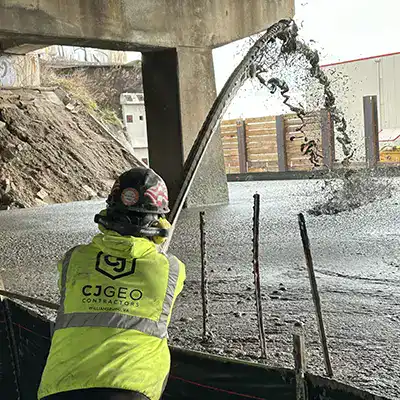
Composition and Physical Properties
Cement and Water
Wet cast densities for cellular concrete span from 25 to 90 lb/cuft, with unconfined compressive strength (UCS) increasing proportionally with density. Strengths range from 30 psi up to 1,500+ psi at 28 days. Density and strength are adjusted by the water-to-cement ratio of the raw slurry and its volumetric proportion to preformed foam. Higher cement content increases unit weight and strength, but also increases material costs.
Supplementary cementitious materials (SCMs) like fly ash or slag and fine aggregates like sand can be incorporated into specialized mix designs. While fine aggregates increase unit density and lower raw material costs, non-cementitious additions reduce overall compressive strength compared to neat cement slurries.
Advanced Foaming Technology
As a factory-certified installer for Aerix Industries, CJGeo utilizes the following advanced synthetic foaming agents:

Traditional preformed foams rely on organic proteins, which can denature from the heat of hydration and collapse, creating dimensional stability issues. Advanced synthetic foaming agents coupled with high-shear colloidal mixing supersede historical lift height restrictions. Replacing thin 1-2 foot lifts with continuous single-lift placements up to 20 feet thick.
Typical Applications
Pipe Abandonment
Cellular concrete enables mile-long pipe abandonments without intermediate excavations. High-volume, single-point placement drastically reduces project costs, mitigates utility strike risks, and accelerates schedules. Learn More>
Annular Space Grouting
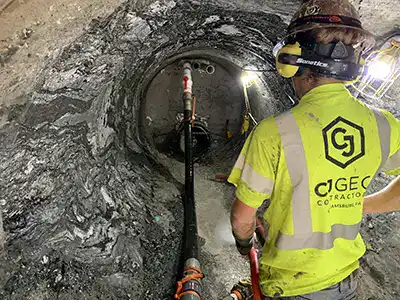
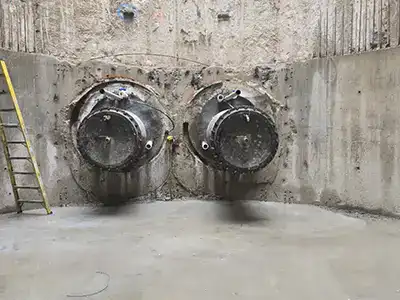
Cellular concrete’s exceptionally low pumping pressures prevent over-pressurization and mitigate carrier pipe buoyancy. This often eliminates multi-stage installations, enabling rapid, highly efficient single-lift placements. Learn More>
Axial Load Reduction
Low-density cellular concrete minimizes dead load overburden adjacent to retaining structures, over compressible soils, and above below-grade infrastructure.
Lateral Load Reduction
Cellular concrete minimizes lateral pressures on retaining structures, while optimizing foundation design and reducing, or even bypassing, deep foundations.
Marine Fills
greater than water, facilitating underwater placement and facilitating zero lateral fluid pressure once cured, minimizing loads on sheet pile walls, docks, and relieving platforms.
Underground Structure & Mine Fills
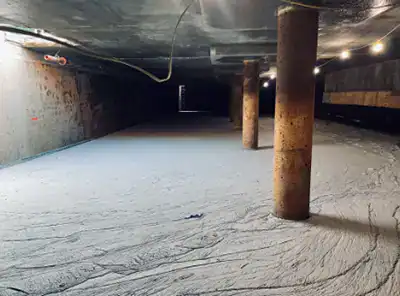
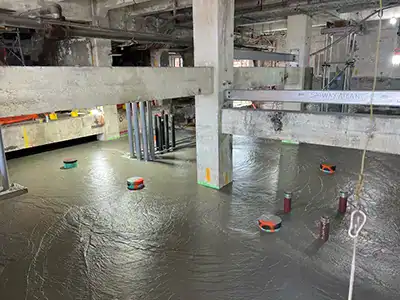
Cellular concrete can abandon and stabilize underground tanks, crawlspaces, and basements by preventing future groundwater infiltration and settlement while satisfying load-bearing requirements.
Been There. Grouted That.®
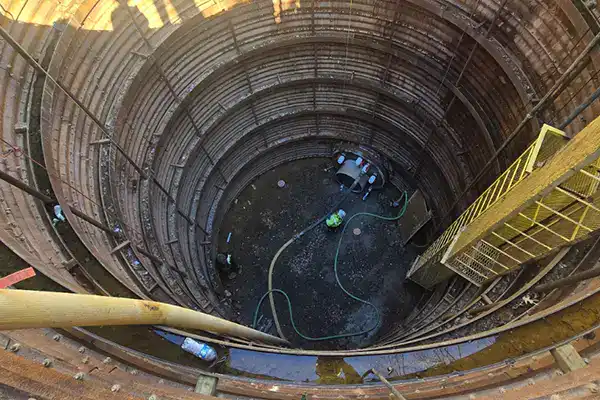
Sugar Creek Annular Space Grouting
For Atlanta's Sugar Creek project, CJGeo grouted the annular space of a 1,500-foot tunnel. To overcome pipe buoyancy risks and massive volume requirements, crews dry-batched and placed 1,400 cubic yards of 30lb CJFill-UL cellular grout, completing the project in just three days. Read More >
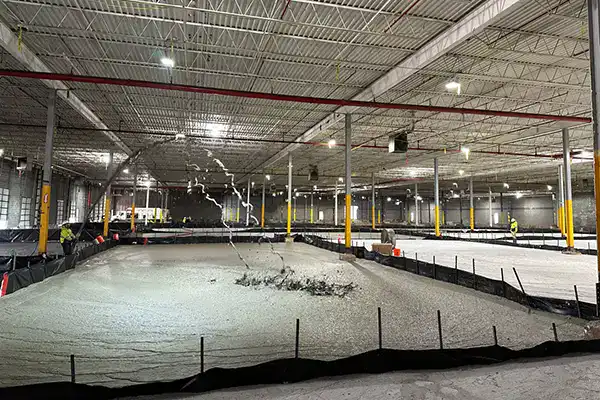
New Jersey Cellular Concrete
When a Secaucus logistics facility sank two feet into compressible soils, CJGeo engineered an undercut and lightweight fill solution. Crews rapidly placed 8,500 cubic yards of cellular concrete to minimize future settlement, ensuring a highly stable base for the renovated space. Read More >
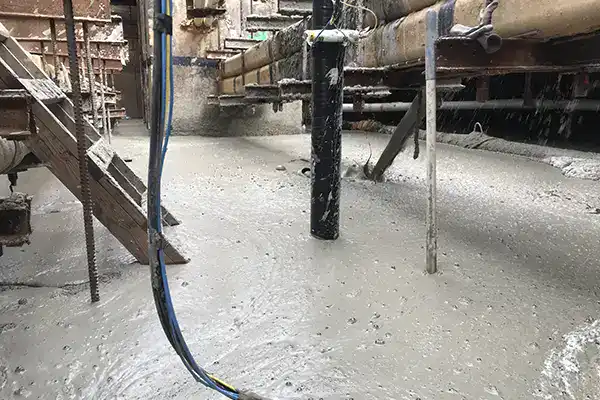
MD 355 Lightweight Fill
To backfill a Maryland pedestrian tunnel without overloading it, crowded utilities made standard fills impossible. CJGeo pumped 990 cubic yards of 30lb CJFill-Ultra Lightweight cellular concrete. Crews safely encapsulated all utilities in just three days, keeping the project on schedule. Read More >
Technical Advantages
Load Reduction
Cellular concrete has adjustable densities ranging from 25PCF-90PCF which substantially reduce loads on sensitive structures and weak subgrades, can fit any shape, and often enable the construction of net-zero-load designs.
Cost Reduction
Utilizing cellular concrete accelerates construction schedules while value-engineering structural designs. Lowering loads often reduces or eliminates the need for expensive deep foundation systems, complex retaining walls, and soil improvement techniques
Risk Reduction
Because moving preformed air bubbles requires less energy than moving aggregates, cellular concrete flows seamlessly at minimal placement pressures.
Increased Speed
Continuous dry-batch cellular concrete generation produces up to 200+ cubic yards per hour, placing material quickly and accelerating construction schedules.
Self-Consolidating & Self-Supporting
Cellular concrete is self-leveling and requires no compaction. Once it’s cured, it is a self-supporting mass that adds zero net load to its surrounding structures.
Chemical Resistance
Unlike EPS geofoam blocks, cellular concrete is inorganic and will not degrade or dissolve upon exposure to hydrocarbons, solvents, or petroleum products.
The CJFill Advantage
Operating as both manufacturers and installers of low-density cellular concrete, CJGeo integrates real-world field experience into the formulation of CJFill®. This specialized line of cellular concrete is engineered to match project design parameters with the appropriate density, compressive strength, and flowability required. The result is a highly predictable solution for abandoning infrastructure, like pipes and culverts, and filling subterranean structures.

Annular Space Grouting
CJFill Underwater Sanded | SF2633
Generation Methods
Matching the exact generation method to individual project volume ensures optimal efficiency. CJGeo manufactures and installs CJFill low-density cellular grout in two ways.
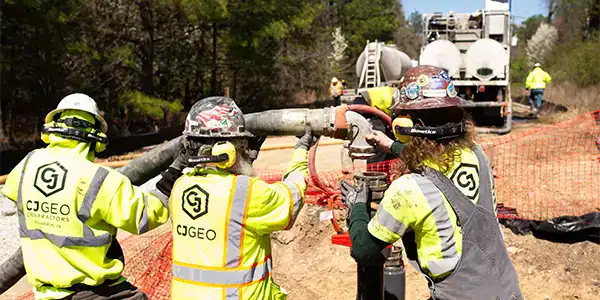
Dry Batch
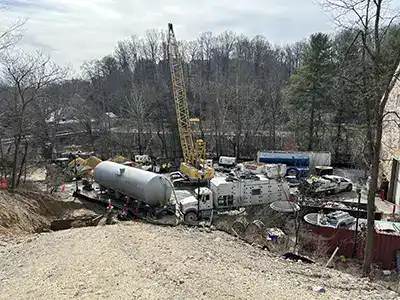
Utilizes bulk cement tankers and automated onsite batch plants. Capable of continuous placement rates up to 200 cubic yards per hour, making it optimal for deep lifts, high-volume mass fills, and long-distance line abandonments.Learn More about Dry Batch cellular concrete generation.
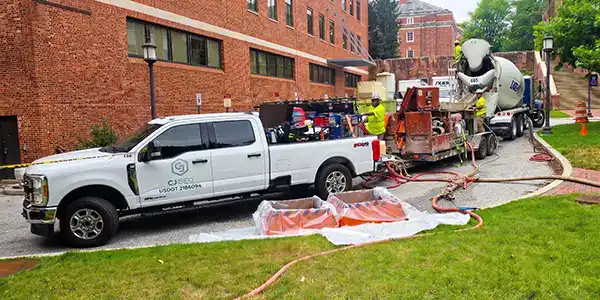
Wet Batch | Lower Volume or Tight Access
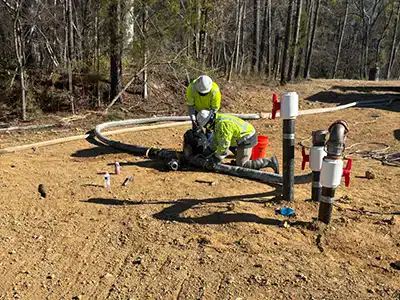
Utilizes ready-mix concrete suppliers to furnish base cement slurry, blending in-line preformed foam onsite at rates up to 75 cubic yards per hour. Ideal for urban job sites, lower volume fills, or restricted access locations. Learn more about Wet Batch / Truck Batch cellular concrete generation.
Alternative Names for Cellular Concrete
Low-density cellular concrete is recognized by various industry designations, depending on geographic region and targeted structural or geotechnical application. Common terms include:
- Low Density Cellular Concrete (LDCC)
- Lightweight Cellular Concrete (LCC)
- Low Density Controlled Low Strength Material (LD-CLSM)
- Lightweight Foamed Concrete (LWFC)
- Pervious Cellular Lightweight Concrete (PCLWC)
- Foamed Concrete Fill (FCF)
- Cellular Lightweight Concrete (CLWC)
- Low Density Foamed Concrete (LDFC)
- Lightweight Foam Concrete Fill (LFCF)
- Lightweight Insulating Concrete (LWIC)
- Cellular Grout
- Foamed Concrete
Speak With An Expert
Facing a challenge?