
Thermal Grouting
Been There. Grouted That.®
CJTherm formulations by CJGeo are specialized thermal grout mixes validated through standardized testing by GeoTherm Design specifications govern maximum thermal resistivity, or rho values. As grout cures and moisture evaporates, air replaces water within the voids, increasing overall thermal resistivity.
Maximum allowable thermal resistivity values vary by utility owner. Most have a maximum allowable thermal resistivity at 0% moisture content, often accompanied by a maximum value at a single digit moisture content such as 4% or 6%. Occasionally, the critical moisture level is used as a specifying point. Critical moisture level is the intercept of the two distinct slopes in a dry-out curve.
CJTherm is available in both high strength and low strength blends.
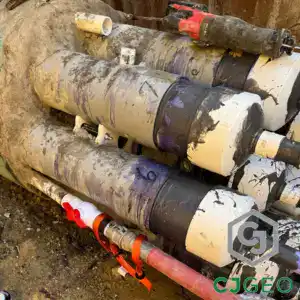
CJGeo installing thermal grout on an electrical ductbank installation with many conduits extending past the bulkhead of a trenchless electrical crossing.
Conduit Buoyancy Control
Carrier buoyancy is a function of the grout density. Thermal grouts are inherently heavy, due to their high silica content and nominal air content.
Buoyancy management is typically done with water filling and designing conduit bundles tolerant of some uplift. Designing conduit systems tolerant of uplift during grouting is critical.
Relative Grouting Pressures
CJTherm mixes feature flow cone times under 45 seconds, delivering high fluidity at low water-cement ratios. This fluid stability minimizes placement pressures. In-annulus pressure and thermistor cells monitor real-time conditions, while multi-stage sacrificial injection lines mitigate head build-up over long runs.
Been There. Grouted That.
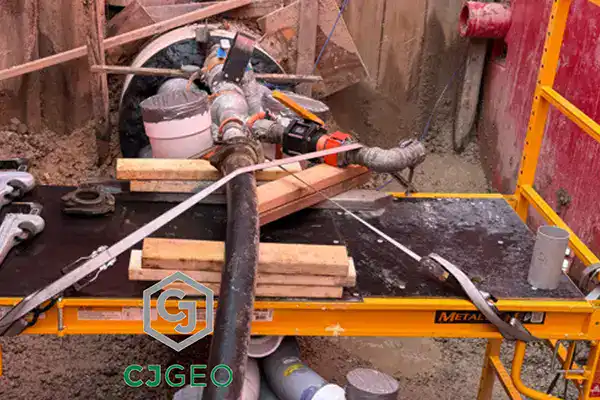
Wisconsin Thermal Grouting
A 250-foot transmission bore under Wisconsin railroad tracks required strict thermal resistivity. When local mixes failed specs, CJGeo placed custom CJTherm TM-5 thermal grout into the annulus, successfully managing ampacity and keeping the heat of hydration safely under 95°F. Read More >

Michigan Thermal Grouting
For a Michigan solar facility tie-in, transmission lines required two jack-and-bore railroad crossings. CJGeo crews placed CJTherm TM-5 thermal grout in both bores in a single day, successfully meeting strict 300psi compressive strength and 65 °C-cm/W thermal resistivity requirements. Read More >

Florida Thermal Grouting
To dissipate heat from high-voltage cables in a 551-foot Florida microtunnel, CJGeo crews placed CJTherm TM-5 thermal grout in a single lift. Continuous monitoring ensured safe placement, and the grout exceeded the strict 60 °C-cm/W thermal resistivity requirement for Duke Energy. Read More >
Generation Methods
Selecting the appropriate CJTherm production method and delivery approach ensures optimal performance for each installation site. Key properties like minimal thermal resistivity, low hydration heat, exceptional fluidity, and long-term dimensional stability heavily depend on aggregate source and composition. Depending on geographic location, CJGeo manufactures and places CJTherm utilizing three primary delivery methods

Ready Mix: In select regional markets, aggregates for thermal grouting are available through local ready-mix supply chains.
Bulk Pneumatic: For high-volume projects nationwide, CJGeo ships bulk pneumatic thermal grout.
Super Sacks: Pre-bagged super sacks offer flexible, highly mobile delivery across the United States, ideal for logistical constraints or specific batching setups.
When local ready-mix plants lack suitable aggregate, CJGeo uses specialized on-site batching equipment to mix and place CJTherm onsite.
Frequently Asked Questions
Speak With An Expert
Facing a challenge?