
Axial Load Reduction
Heavy traditional backfills, such as soil and crushed stone, exert massive downward forces that overstress weak subgrades as well as buried utilities and structures. Axial load reduction replaces these dense materials with advanced lightweight fills to actively minimize overburden, protecting sensitive infrastructure and preventing geotechnical failure. CJGeo manufactures and installs low-density cellular concrete and geotechnical polyurethanes to replace traditional soil and stone in load-critical applications.
Common Applications
Raising Grade Over Compressible Soils
Eliminate the need for long, expensive soil surcharge periods or complex deep foundation systems by using low-density cellular concrete as lightweight fill. Learn More>
Utility Overburden Reduction
Protect aging or fragile utility lines, tunnels, and culverts from the weight of traditional fill materials.
Differential Settlement Prevention
Replace traditional soil with load-reducing cellular concrete to mitigate settlement that causes hazardous transitions between bridge abutments and their soil-supported approach slabs.
Related Materials
CJFill Cellular Concrete
Tailored to meet engineering specifications, CJGeo’s CJFill® low-density cellular concrete mix designs range from CJFill Ultra-Lightweight, CJFill Higher-Strength, CJFill-Sanded, and CJFill-Underwater formulations. Learn More

Generation Methods
Matching the exact generation method to individual project volume ensures optimal efficiency. CJGeo manufactures and installs CJFill low-density cellular grout in two ways.
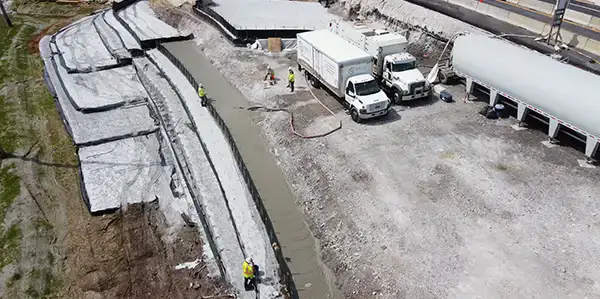
Dry Batch | Higher Volume or Deep Lifts
Computerized on-site plants utilize high-energy colloidal mixers to combine dry materials and water, creating a structural matrix that protects entrained bubbles for lifts up to 10 feet. Three highly mobile tandem-chassis plants maximize efficiency, reliably placing up to 200+ cubic yards per hour. Learn More about Dry Batch cellular concrete generation.
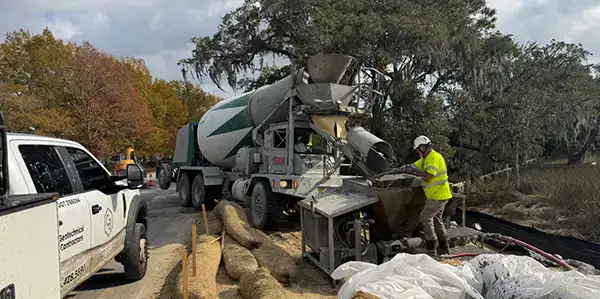
Wet Batch | Lower Volume or Tight Access
Utilizing traditional ready-mix trucks to deliver cement slurry, foam is injected directly on-site. CJGeo’s three dedicated wet batch systems generate up to 70 cubic yards per hour, ensuring an economical, highly efficient solution for smaller placements and confined job sites. Learn more about Wet Batch / Truck Batch cellular concrete generation.
CJGrout Polyurethane Grouts
CJGrout® polyurethane grouts have unique properties developed to solve targeted geotechnical and structural problems. From void filling beneath existing structures to spray-applied lightweight fill applications, there’s a CJGrout for that. Learn More

Installation Process
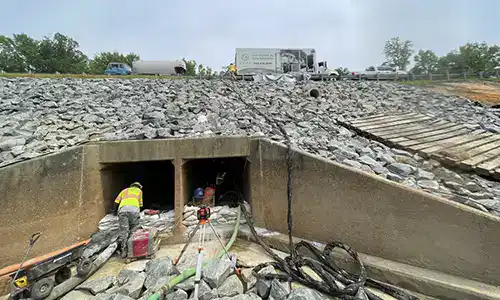
Equipment
The entire polyurethane grouting operation runs from a self-contained box truck. Inside, a generator and heaters prepare the unmixed liquids at a 1:1 ratio before pumping them through heated hoses. Self-contained units house primary and secondary formulations, enabling low- and high-mobility grouting on the same project.
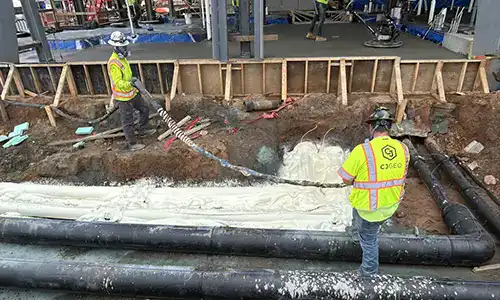
Grout Installation
A specialized pump mixes the two liquid components at a precise 1:1 ratio at the nozzle, initiating an immediate chemical reaction upon application. This high-speed impingement system allows for stable, continuous build-up on horizontal, near-vertical, or overhead surfaces. Reaching 95% cure in just 15 minutes, these high-reactivity structural foams are perfect for tunnel annulus bulkhead sprays, overbreak fills, and similar applications.
Been There. Grouted That.®
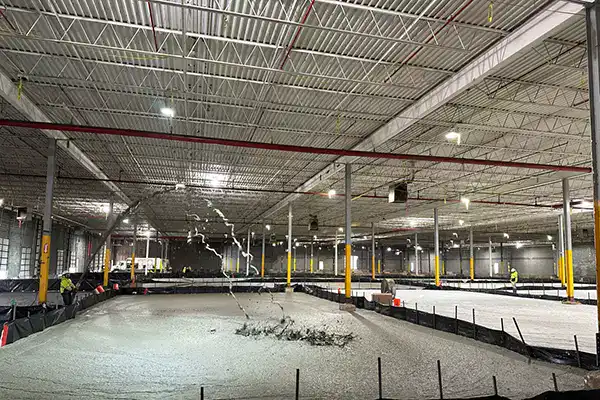
New Jersey Cellular Concrete
A Secaucus warehouse settled two feet over compressible soils. To limit future settlement for a food-grade conversion, CJGeo engineered an undercut plan and placed 8,500 cubic yards of lightweight cellular concrete. Crews safely mitigated uplift, placing up to 1,100 CY per day. Read More >
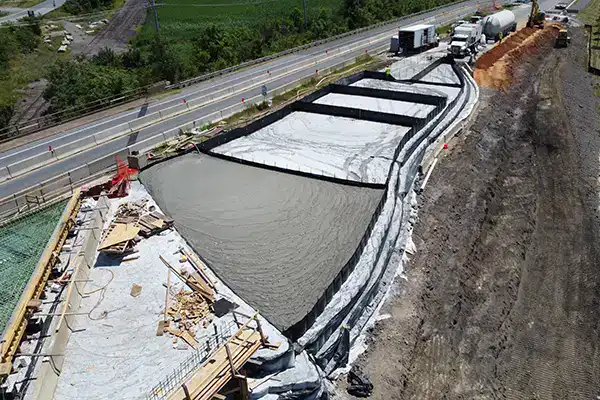
30k CY Lightweight Embankment
To raise and widen bridge embankments over compressible soils in Baltimore, CJGeo placed 30,000 CY of lightweight cellular concrete. This 25lb/cuft fill prevented settlement, optimized deep foundations, and saved hundreds of thousands of dollars compared to alternative aggregates. Read More >
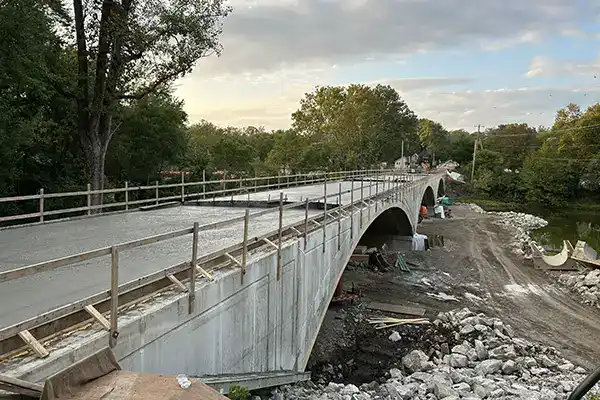
Arch Bridge Lightweight Fill
To reduce load stresses on an Ohio arch bridge, CJGeo replaced heavy standard fill with 1,600 CY of CJFill-Ultra Lightweight cellular concrete. Poured over four days, the fast-curing 30 pcf material exceeded strength requirements and allowed crews to place road base the very next day. Read More >
The Low-Density Cellular Concrete Advantage
Weight Credit Calculation
Excavating and replacing heavy native soil with an ultra-lightweight fill balances new structural and geotechnical loads, ensuring the underlying compressible soil isn’t overstressed.
Accelerated Schedules
Project timelines are significantly compressed by bypassing the need for deep foundations, load-distribution slabs, and long surcharge wait times.
Rapid Placement
Continuous on-site batching allows for high-volume placements of up to 200 cubic yards of LDCC per hour without requiring any mechanical compaction.
Speak With An Expert
Facing a challenge?