
Polyurethane Grouting
Millions of pounds and counting.
Polyurethane grouting delivers a fast, clean, and highly controlled alternative to traditional cement for stabilizing and leveling structures, from commercial floors to heavy highway bridge approaches. Injected under pressure, two-part liquid polymers spread through subterranean voids before rapidly expanding and hardening.
Low-mobility foams exert immense expansive force to precisely lift heavy structures, while high-mobility formulations focus on void filling and deep soil compaction. Curing in minutes with a minimal equipment footprint, polyurethane injection drastically reduces operational downtime and overall project costs.
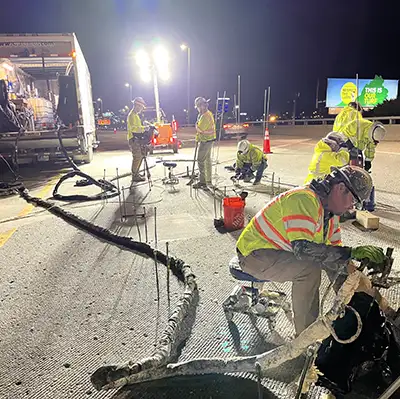
Polyurethane Compaction Grouting | CJGrout 30NHL | SF2461
Related Services
Undersealing
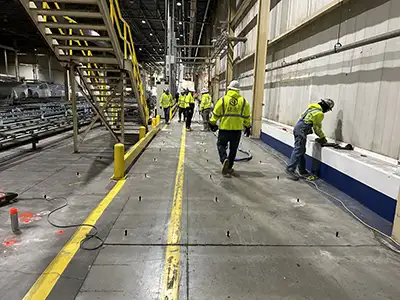
Polyurethane grouts can be injected to fill small voids below concrete slabs where water accumulates and seeps through cracks or joints to the surface.
Void Filling
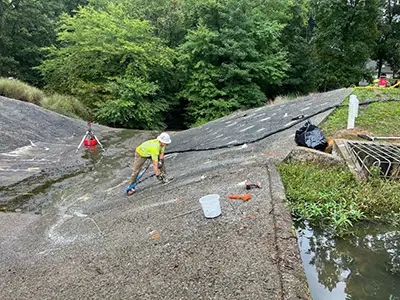
Polyurethane grouts can be injected below surfaces where voids exist, expanding to fill cavities beneath structures while adding minimal load compared to flowable fill.
Compaction Grouting
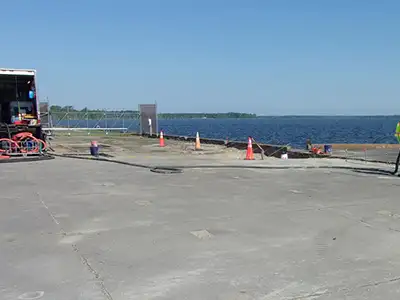
Polyurethane grouts are injected through small steel tubing to depths up to 35’ in stages. As the polyurethane expands, it displaces and compresses the adjacent soil, curing to 95% within 15 minutes. Learn More
Concrete Lifting
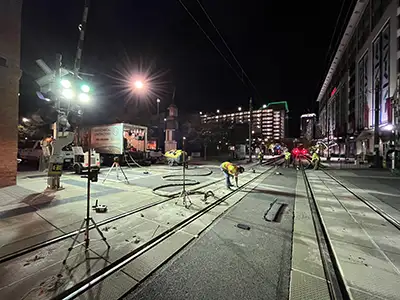
Polyurethane grouts expand upon injection with controlled upward pressure to lift and level sunken structures. Often used in combination with polyurethane compaction grouting to stabilize soils below structures. Learn More
Leak Stopping
Polyurethane grouts can be used to fill voids and block water passages through cracks and joints, thereby preventing water intrusion and stabilizing structures.
Pipe, Box Culvert, & Sinkhole Repair
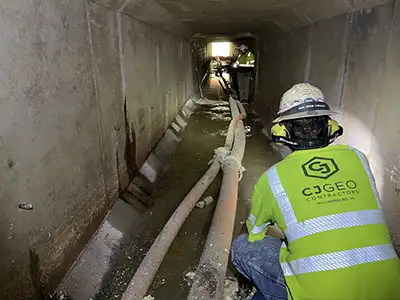
Polyurethane grouts can be used to fill sinkholes and voids and to seal leaks and joints in stormwater structures that caused the soil displacement. Learn More
Been There. Grouted That.®
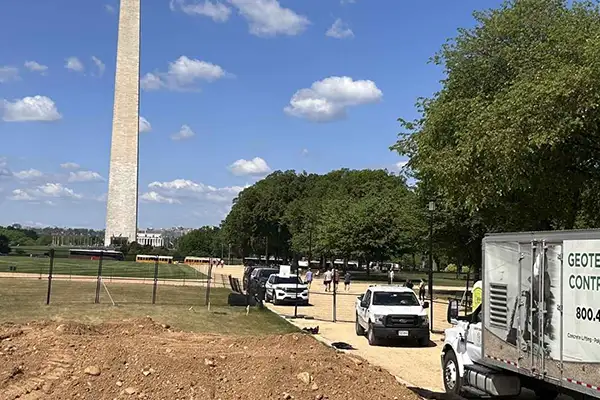
National Mall Sinkholes
When chronic sinkholes closed a section of the National Mall, CJGeo utilized polyurethane grouting to stabilize the site. Crews injected 55,000 lbs of structural foam across a 16,000-sq-ft grid to fill voids, providing a solid base for reconstruction. Read More
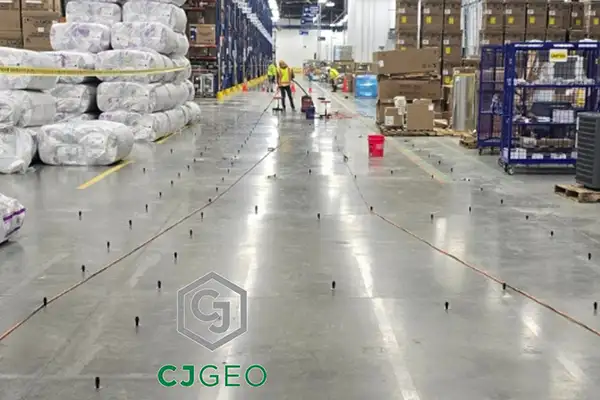
Tennessee Polyurethane Grouting
Slab curl caused damaging joint deflection at a 1M sq ft TN distribution center. CJGeo crews expertly undersealed 45,000 linear ft of joints via polyurethane grouting. Working solely at night, the team restored the floor with zero disruption to the 24/6 facility. Read More
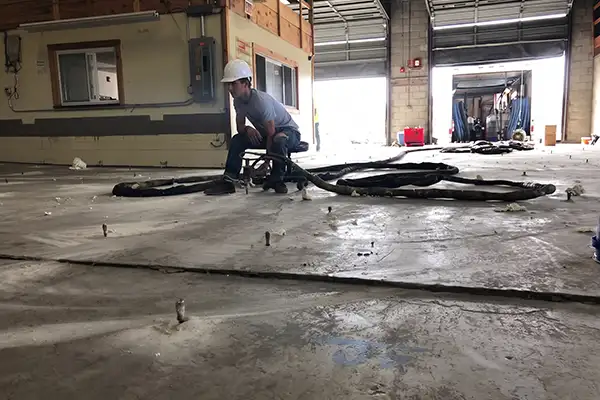
Warehouse Floor Lifting
When 25,000 sq ft of a military warehouse floor settled up to 4 inches, CJGeo provided a value-engineered solution using lightweight CJGrout polyurethane. In under 10 days, crews expertly filled sub-slab voids and lifted the concrete and embedded rails, easily handling the heavy capacity requirements. Read More
Advantages of Polyurethane vs Cementitious Grout
Cleaner
Utilizing mechanical packers for containment, polyurethane injection delivers a clean, highly controlled alternative to traditional cement. Rapid cure time and easy surface remediation make it ideal for food-preparation facilities and potable water environments.
Less Disruptive
Polyurethane grouting uses small injection holes. Drilling is rapid and discreet, and the injection itself is virtually noiseless. Equipment is self-contained in a box truck that can stage up to 400 feet away, keeping heavy machinery out of sight and minimizing disruption.
Immediate Traffic
Polyurethane grouting minimizes operational downtime by reaching a 95% cure within 15 minutes. The treated area instantly resumes normal operations, providing the bearing capacity required to support heavy trucks, industrial equipment, and trains.
Fast
Engineered for speed, polyurethane grouting is up to 12 times faster than cement. Equipment design facilitates repairs to begin within minutes of arrival. Smaller drill holes and a wider lifting radius allow repairs to be completed faster and more efficiently.
Lightweight
Polyurethane grouts are exceptionally lightweight (2–8 PCF), minimizing overburden on soils and preventing resettlement. With strength properties similar to soil, polyurethane grout is a versatile alternative to EPS foam blocks for lightweight fill applications.
Waterproof
High-density polyurethanes are hydrophobic and can be installed directly in water, facilitating installation into environments with active flow. Because of the near-immediate curing, water-stopping jobs are fast and easily tested on site for efficacy.
The CJGrout® Advantage
CJGrout®, CJGeo’s own line of polyurethane grouts, is formulated to suit a wide variety of projects, drawing on CJGeo’s extensive experience. Different formulations offer a range of properties tailored to repair needs, such as faster or slower expansion, hydro-insensitivity, and different lifting pressures, ensuring there’s the right product for each job.


Compaction Grouting
CJGrout 35NHV | SF5456
Undersealing
CJGrout 20SDB | SF6280
Concrete Lifting
CJGrout 40NHL | SF3229
Pipe, Culvert & Sinkhole Repair
CJGrout 35NHV | SF4399
Polyurethane Compaction Grouting
CJGrout 22SHV | SF4109
Void Filling
CJGrout 22SHV | SF5016
Installation Process
Equipment
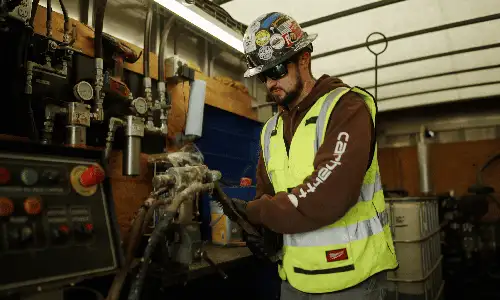
The entire polyurethane grouting operation runs from a self-contained box truck. Inside, a generator and heaters prepare the unmixed liquids at a 1:1 ratio before pumping them through heated hoses. Self-contained units house primary and secondary formulations, enabling low- and high-mobility grouting on the same project.
Site Preparation
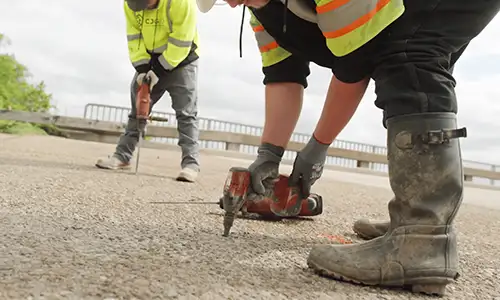
Pneumatic drills are used to create a precise grid of 5/8" injection holes, keeping the process fast, quiet, and nearly invisible once patched. Mechanical packers, or steel tubing if injecting deep below the surface, are then inserted to ensure clean, targeted placement of material beneath structures.
Grout Installation
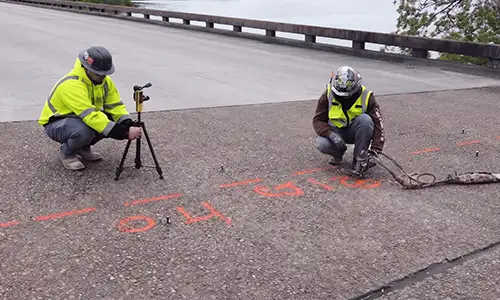
A specialized pump mixes the two liquid components at a precise 1:1 ratio at the nozzle. Once injected into voids, the liquid expands into a rigid, high-density foam that compacts surrounding soils. Elevations and movement are monitored with laser levels. Reaching 95% cure in just 15 minutes allows structures to be reopened almost immediately.
Frequently Asked Questions
Speak With An Expert
Facing a challenge?
