
Types of Lightweight Fill
Been There. Grouted That.®
When constructing over weak subgrades, aging utilities, or behind retaining walls, traditional soil and stone backfills can sometimes be too heavy. Standard aggregates routinely weigh over 120 pounds per cubic foot (PCF), placing significant downward stress on the ground and exerting outward pressure against walls. Instead of compensating for this weight by over-designing structures with deep foundations, wider footings, or months of soil surcharging, the most efficient solution is to simply lighten the load by replacing traditional aggregates and soil with lightweight fill.
However, not all lightweight fills are created equal. There are multiple types of lightweight fill, ranging from aggregates to styrofoam. Selecting the right material comes down to each project’s unique logistical, structural, and geotechnical needs.
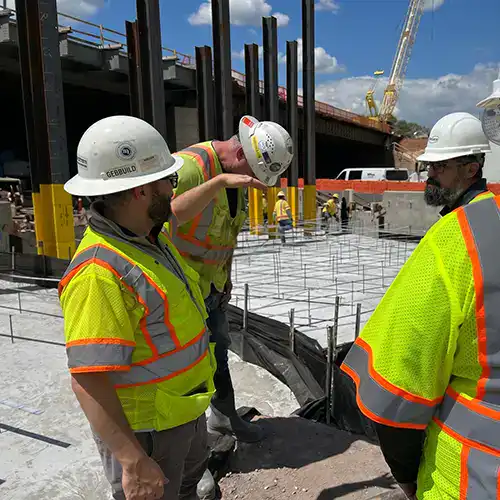
Types of Lightweight Fill
| Material Type | Typical Density (PCF) | Placement Method | Compaction Required? | Logistical Footprint |
|---|---|---|---|---|
| Cellular Concrete (CJFill®) | 25–80 PCF | Pumped (up to 1 mile) | No, Self-Consolidating | Minimal (On-site continuous batching) |
| Geotechnical Polyurethane | 2–8 PCF | Injected / Sprayed | No, Self-Expanding | Minimal (Box truck/trailer rig) |
| Expanded Polystyrene (EPS) | 1.5–3 PCF | Manually Stacked Blocks | No | 1:1 hauling ratio; massive staging |
| Foamed Glass Aggregate | ~25 PCF (in-place) | Trucked in, stockpiled and dumped | Yes | 1.25 hauling ratio due to compaction, stockpiling |
| Lightweight Expanded Shale Aggregate | 40–60 PCF | Trucked in, stockpiled and dumped | Yes | Dump truck delivery, stockpiling, and mechanical compaction |
Lightweight Fill Manufactured and Installed by CJGeo
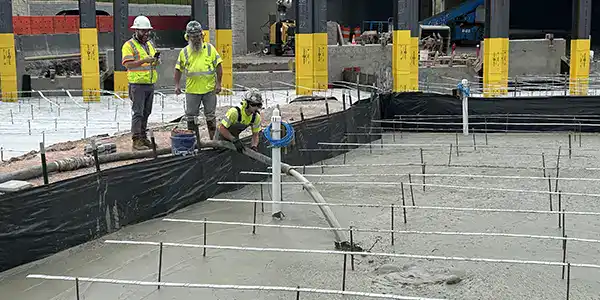
Low-Density Cellular Concrete
Low-density cellular concrete is a self-supporting, self-consolidating fill with densities from 25 to 80 PCF, as low as 1/4 the weight of traditional backfill. Ideal for raising grade over weak subgrades and backfilling retaining walls without compaction, cellular concrete offers unmatched versatility.
Tailored to meet engineering specifications, CJGeo’s CJFill low-density cellular concrete mix designs range from CJFill Ultra-Lightweight, CJFill Higher-Strength, CJFill-Sanded, and CJFill-Underwater formulations.
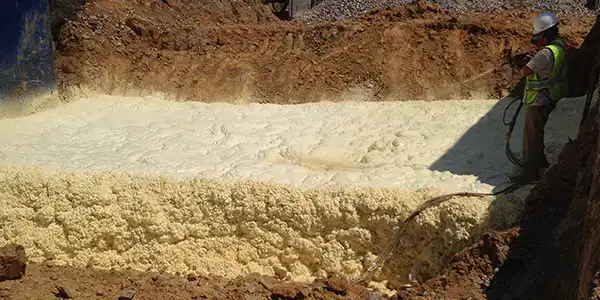
Geotechnical Polyurethanes
High-density geotechnical polyurethanes are injected as liquids that rapidly expand into rigid cellular plastics. Conforming to any shape, these lightweight polymers weigh between 2 and 10 PCF and provide allowable bearing capacities starting around 3,000 PSF.
CJGrout polyurethane grouts have unique properties developed to solve targeted geotechnical and structural problems. From void filling beneath existing structures to spray-applied lightweight fill applications, there’s a CJGrout for that.
Been There. Grouted That.®
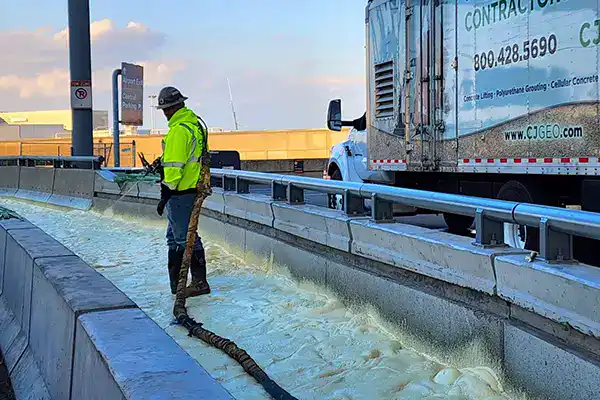
Logan Airport Lightweight Fill
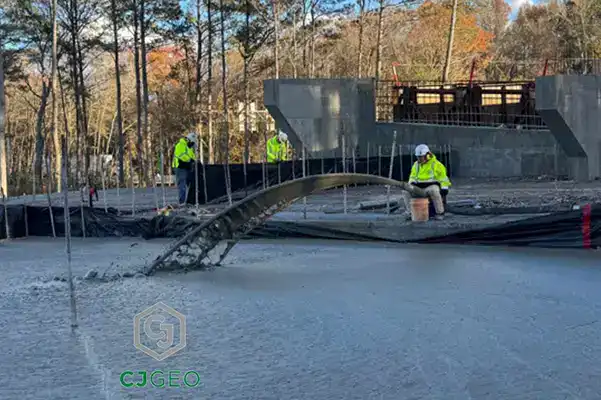
At Logan Airport, a gap between curved barrier walls on an existing podium required ultra-lightweight fill. CJGeo crews pumped 64 cubic yards of low-density CJGrout 20SDB to seamlessly fill the irregular space in one shift, allowing the contractor to pour the topping slab the very next day. Read More >
Route 58 Flyover Ramp Lightweight Fill
Panel 19 of the National Mall in Washington, DC, is a high-traffic, 16,000-square-foot lawn area situated directly above a WMATA metro tunnel. For over a decade, this specific section of the Mall was plagued by chronic sinkhole formation, creating significant safety hazards and maintenance challenges. Read More >
D.C. Parking Deck Lateral Load Reduction
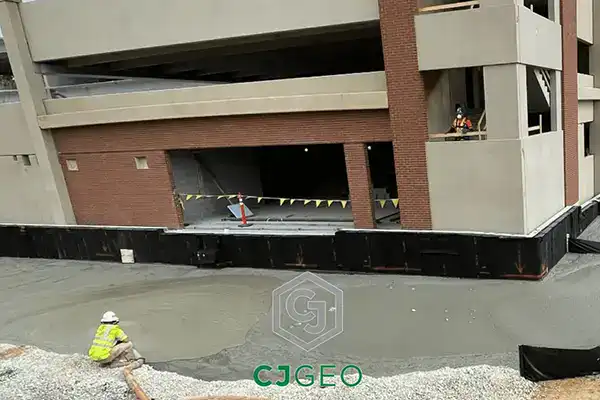
To backfill a new D.C. parking deck engineered with zero tolerance for lateral earth pressure, CJGeo placed 25 lb/cuft CJFill-Ultra Lightweight cellular concrete. This self-supporting, load-reducing fill safely brought the excavated area to grade without compromising structural integrity. Read More >
Alternative Lightweight Fills
Expanded Polystyrene (EPS)
Consisting of large blocks of styrofoam manually stacked on-site, EPS is extremely lightweight, reaching densities as low as 1.5 PCF. Because it is a solid block, it does not require formwork for above-grade installations. However, EPS requires a highly inefficient 1-to-1 hauling ratio (one cubic yard hauled equals exactly one cubic yard placed in the field), demands massive on-site staging areas, and is highly susceptible to petroleum solvent attack.
Foamed Glass
Created by burning glass powder mixed with a foaming agent, foamed glass aggregate resembles cellular concrete broken into gravel. While it provides a low in-place density of approximately 25 PCF, it requires physical compaction. Because of this mechanical compaction loss, it requires approximately 1.25 cubic yards of hauling for every single cubic yard of in-place material.
Lightweight Expanded Shale Aggregate
Produced by firing shale, clay, or slate in a rotary kiln to create a porous, lightweight gravel. While it lowers in-place density to approximately 40 to 60 PCF (roughly half the weight of traditional stone), it still functions as a traditional aggregate. This means it requires constant dump truck deliveries, large on-site stockpiles, mechanical compaction, and heavy grading equipment for placement.
The CJGeo Technical Advantage
Zero Compaction Loss
Unlike foamed glass or expanded shale aggregates, highly fluid cellular concrete and expansive polyurethanes require absolutely zero mechanical compaction, preventing material waste and schedule delays.
Logistical Efficiency
Pumping flowable fills directly from on-site batching equipment completely bypasses the expensive transportation ratios, heavy truck traffic, and massive staging areas required to manually stack EPS blocks or stockpile large aggregate deliveries.
Seamless Void Filling
Pumpable liquids effortlessly conform to complex geometries, tight annuluses, and irregular excavations without the labor-intensive cutting, shaping, and measuring required to install rigid EPS blocks around utilities.
Speak With An Expert
Facing a challenge?