
Lateral Load Reduction
Traditional select fills and soils, weighing between 90 and 150 PCF, exert massive active earth pressure against retaining structures. To compensate for these horizontal forces, structural designs frequently require oversized stem walls, densely spaced rebar, wider footings, and expensive deep foundations. Lateral load reduction utilizing advanced lightweight materials removes the outward forces that engineers typically spend hours designing against. CJGeo manufactures and installs low-density cellular concrete to provide stable, self-supporting backfill solutions that protect critical infrastructure and optimize structural designs.
Common Applications
Retaining and Foundation Walls
Value-engineer structural walls by minimizing active earth pressure, eliminating the need for over-designed concrete walls or expansive foundation footprints.
Bridge Abutments
Provides a highly stable backfill that prevents lateral displacement of abutment walls while simultaneously protecting any underlying legacy utilities from excessive overburden.
Zero-Tolerance Structures
Ideal for adjacent structures, deep basements, and parking garages that dictate near-zero allowable lateral loads post-installation.
Types of Wall Backfill
| Type of Fill | Traditional Backfill | LESA (Expanded Shale) | Foam Glass Aggregate | LLDC (Cellular Concrete) | EPS Geofoam |
| Density | 110 to 135 pcf | 40-60 pcf | 18 to 25 pcf | 25 to 35 pcf | 1.0-3.0 pcf |
| Equivalend Fluid Pressure Coeficient | 35-50 pcf | 12-18 pcf | 10-15 pcf | O pcf | O pcf |
| Active Earth Pressure | 0.30-0.35 | ~0.25-0.30 | 0.22-0.28 | 0 (Once Cured) | 0 (Post Assembly) |
| Lift Height | 6”-8” | 8”-12” | 12”-2’ | 2’-30’, depending | Custom cut |
| Internal Friction Angle | 30-34 degrees | 38-42 degrees | 38-42 degrees | 35 degrees OR Cohesive mass | N/A - Rigid blocks |
| Compaction / Waste Factor | 10% to 15% | 10% to 15% | 20% to 30% | 0% Self-Consolidating | 5%-10% |
| Placement Method | Roller Compacted 30-50 CY/hr | Vibratory Machinery 40-60 CY/hr | Tracked Equipment 40-60 CY/hr | Pumped 200+ CY/hr | Hand installed 20-30 CY/hr |
| Slope and Bench | Benching + Permanent Slope | Benching + Permanent Slope | Benching + Permanent Slope | No Benching + Permanent Slope | Benching + Permanent Slope |
Related Materials
CJFill Cellular Concrete
Tailored to meet engineering specifications, CJGeo’s CJFill low-density cellular concrete mix designs range from CJFill Ultra-Lightweight, CJFill Higher-Strength, CJFill-Sanded, and CJFill-Underwater formulations. Learn More

Generation Methods
Matching the exact generation method to individual project volume ensures optimal efficiency. CJGeo manufactures and installs CJFill low-density cellular grout in two ways.
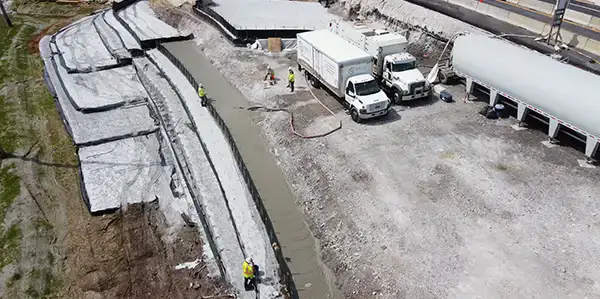
Dry Batch | Higher Volume or Deep Lifts
Computerized on-site plants utilize high-energy colloidal mixers to combine dry materials and water, creating a structural matrix that protects entrained bubbles for lifts up to 10 feet. Three highly mobile tandem-chassis plants maximize efficiency, reliably placing up to 200+ cubic yards per hour. Learn More about Dry Batch cellular concrete generation.
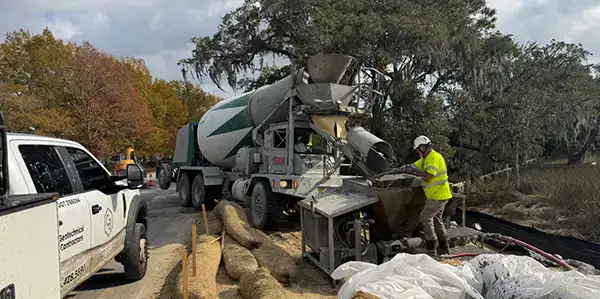
Wet Batch | Lower Volume or Tight Access
Utilizing traditional ready-mix trucks to deliver cement slurry, foam is injected directly on-site. CJGeo’s three dedicated wet batch systems generate up to 70 cubic yards per hour, ensuring an economical, highly efficient solution for smaller placements and confined job sites. Learn more about Wet Batch / Truck Batch cellular concrete generation.
CJGrout Polyurethane Grouts
CJGrout polyurethane grouts have unique properties developed to solve targeted geotechnical and structural problems. From void filling beneath existing structures to spray-applied lightweight fill applications, there’s a CJGrout for that. Learn More

Installation Process
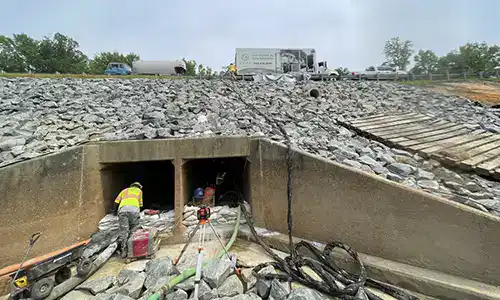
Equipment
The entire polyurethane grouting operation runs from a self-contained box truck. Inside, a generator and heaters prepare the unmixed liquids at a 1:1 ratio before pumping them through heated hoses. Self-contained units house primary and secondary formulations, enabling low- and high-mobility grouting on the same project.
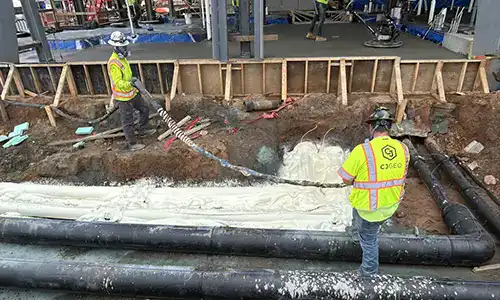
Grout Installation
A specialized pump mixes the two liquid components at a precise 1:1 ratio at the nozzle, initiating an immediate chemical reaction upon application. This high-speed impingement system allows for stable, continuous build-up on horizontal, near-vertical, or overhead surfaces. Reaching 95% cure in just 15 minutes, these high-reactivity structural foams are perfect for tunnel annulus bulkhead sprays, overbreak fills, and similar applications.
Been There. Grouted That.®
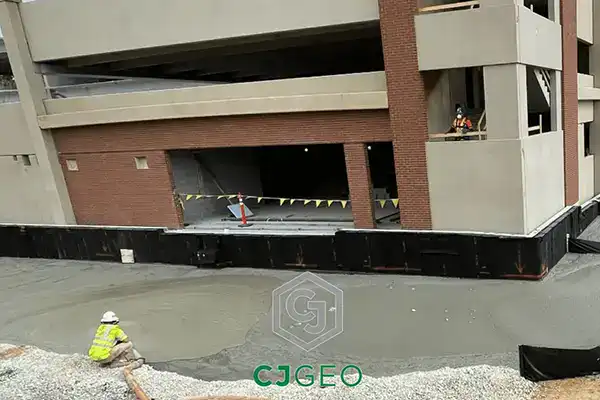
D.C. Parking Deck Lateral Load Reduction
To protect a D.C. parking deck built into a slope, the structure required zero lateral earth pressure. CJGeo poured 25 pcf CJFill-Ultra Lightweight cellular concrete to backfill the area, creating a self-supporting mass that safely brought the site to grade while eliminating lateral forces. Read More >
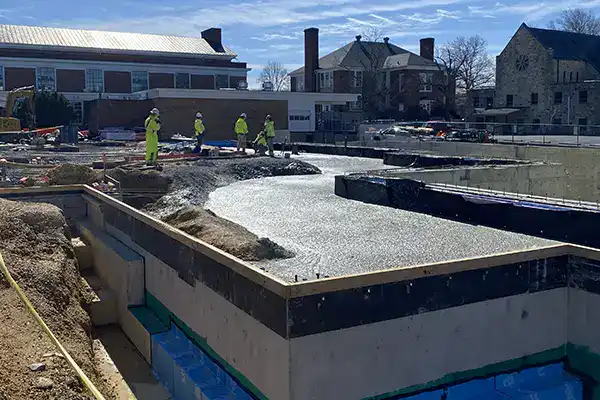
Basement Wall Load Reducing Fill
At Washington & Lee University, an unbraced 15-foot basement wall required backfill before supporting floors were built. To eliminate the need for temporary bracing, CJGeo placed CJFill-Ultra Lightweight load-reducing fill over three days, allowing construction to safely continue. Read More >
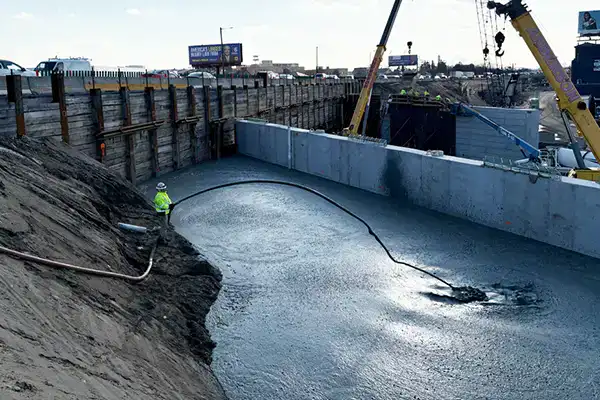
Pennsylvania cellular concrete
For an I-95 bridge widening, the abutment required lightweight backfill to reduce load stresses. CJGeo placed 25 pcf CJFill-Ultra Lightweight cellular concrete. Using custom on-site dry-batch equipment, crews pumped material 400 feet, staying on schedule despite freezing winter conditions. Read More >
The Technical Advantage
Self-Supporting Mass
Because cellular concrete requires no mechanical compaction and cures into a rigid block, it actively removes horizontal stresses from the structural design
Cost Efficiency
Value-engineer the project by reducing the steel and concrete required for heavily reinforced retaining systems.
Seamless Installation
Pumping highly flowable, self-consolidating LDCC drastically reduces placement times compared to mechanical compaction or manually stacking EPS blocks, frequently condensing multi-week installations into a matter of hours.
Speak With An Expert
Facing a challenge?