
Mass & Load Reducing Fills
CJGeo’s advanced lightweight fills replace heavy aggregates to protect sensitive infrastructure, accelerating schedules and eliminating deep foundations and long surcharge periods. CJFill® low-density cellular concrete, ranging from 25–80 PCF, is manufactured and installed on-site to reduce axial and lateral loads for construction over weak soils, marine fills, and subgrade abandonments. For ultra-lightweight requirements, CJGrout® geotechnical polyurethane, as light as 2 PCF, delivers EPS-like density in a seamlessly injected, form-fitting polymer.
Related Services
Axial Load Reduction
Minimizes dead load overburden adjacent to retaining structures, over compressible soils, and above below-grade infrastructure. Learn More >
Lateral Load Reduction
Utilizes specially formulated cellular concrete mix designs that achieve densities slightly greater than water to facilitate underwater placement. Learn More >
Marine Fills
Utilizes specially formulated cellular concrete mix designs that achieve densities slightly greater than water to facilitate underwater placement. Learn More >
Underground Structure & Mine Fills
Reliably fills and stabilizes underground tanks, crawlspaces, basements, and mines to prevent settlement and groundwater infiltration. Learn More >
Void Filling
Both low-density cellular concrete and geotechnical polyurethane grouts effectively fill large voids and stabilize structures with minimal footprint or downtime. Learn More >
Related Materials
CJFill Cellular Concrete
Tailored to meet engineering specifications, CJGeo’s CJFill low-density cellular concrete mix designs range from CJFill Ultra-Lightweight, CJFill Higher-Strength, CJFill-Sanded, and CJFill-Underwater formulations. Learn More

Generation Methods
Matching the exact generation method to individual project volume ensures optimal efficiency. CJGeo manufactures and installs CJFill low-density cellular grout in two ways.
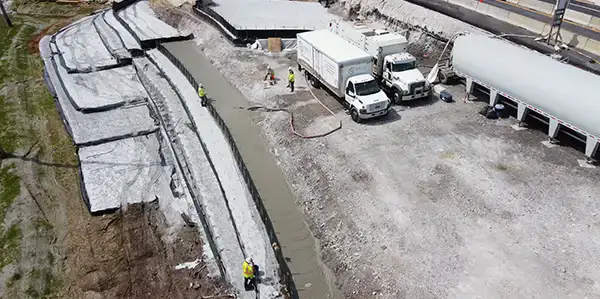
Dry Batch | Higher Volume or Deep Lifts
Computerized on-site plants utilize high-energy colloidal mixers to combine dry materials and water, creating a structural matrix that protects entrained bubbles for lifts up to 10 feet. Three highly mobile tandem-chassis plants maximize efficiency, reliably placing up to 200+ cubic yards per hour. Learn More about Dry Batch cellular concrete generation.
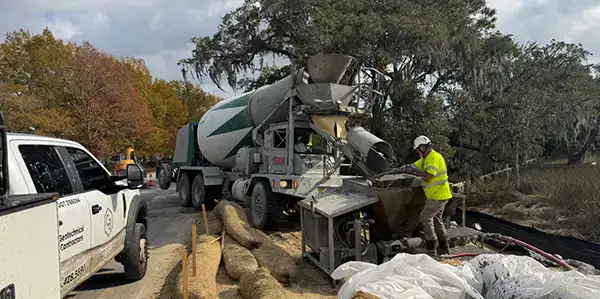
Wet Batch | Lower Volume or Tight Access
Utilizing traditional ready-mix trucks to deliver cement slurry, foam is injected directly on-site. CJGeo’s three dedicated wet batch systems generate up to 70 cubic yards per hour, ensuring an economical, highly efficient solution for smaller placements and confined job sites. Learn more about Wet Batch / Truck Batch cellular concrete generation.
CJGrout Polyurethane Grouts
CJGrout polyurethane grouts have unique properties developed to solve targeted geotechnical and structural problems. From void filling beneath existing structures to spray-applied lightweight fill applications, there’s a CJGrout for that. Learn More

Installation Process
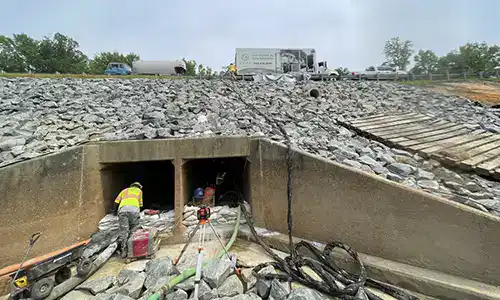
Equipment
The entire polyurethane grouting operation runs from a self-contained box truck. Inside, a generator and heaters prepare the unmixed liquids at a 1:1 ratio before pumping them through heated hoses. Self-contained units house primary and secondary formulations, enabling low- and high-mobility grouting on the same project.
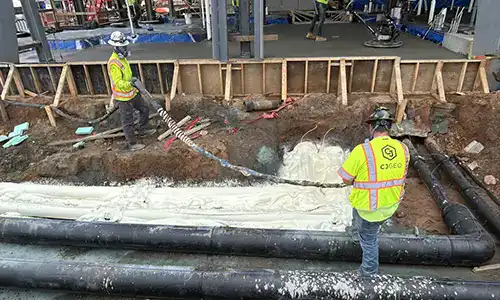
Grout Installation
A specialized pump mixes the two liquid components at a precise 1:1 ratio at the nozzle, initiating an immediate chemical reaction upon application. This high-speed impingement system allows for stable, continuous build-up on horizontal, near-vertical, or overhead surfaces. Reaching 95% cure in just 15 minutes, these high-reactivity structural foams are perfect for tunnel annulus bulkhead sprays, overbreak fills, and similar applications.
Beyond Traditional Lightweight Fill
Load Reduction
Cellular concrete has adjustable densities ranging from 25PCF-80PCF, while polyurethane grouts are as light as 2PCF. Both materials substantially reduce loads on sensitive structures and weak subgrades, can fit any shape, and often enable the construction of net-zero-load designs.
Reduced Costs
Utilizing lightweight fills accelerates construction schedules while value-engineering structural designs. Lowering loads often reduces or eliminates the need for expensive deep foundation systems, complex retaining walls, and soil improvement techniques.
Increase Speed
Polyurethane and low-density cellular concrete are both self-consolidating, removing the need for compaction. With mobile batch plants producing up to 200+ cy/hour, placement is much faster, and lifts can be much higher.
Speak With An Expert
Facing a challenge?