
Permeation Grouting
Been There. Grouted That.®
Permeation grouting utilizes low-viscosity grouts to uniformly saturate subgrade soils and fill. An alternative to low-mobility grouting that prioritizes densification, permeation grouting reduces permeability while increasing stability and bearing capacity. Permeation grouting excels in saturated environments and confined job sites, where it’s installed through TAM tubing via advanced sonic drilling.
Geotechnical analysis ensures optimal grout compatibility with soil mechanics. Acrylics, mineral-based colloidal silica, or specialized polyurethanes may be specified to match individual subgrade characteristics. These formulations establish an impermeable barrier that halts groundwater infiltration while maintaining soil consistency suitable for future excavation.
Related Services
Tunnel Break-In/Out Grouting
Permeation grouting locks soil together to control groundwater and maintain structural integrity during tunnel break-ins and break-outs. For leaking shafts, these low-viscosity formulations stop active leaks
Leak Stopping
Halt active water infiltration through the precise injection of engineered formulations to create a robust, impermeable barrier. This technique effectively severs groundwater migration pathways, safeguarding infrastructure.
SOE Gap Closure
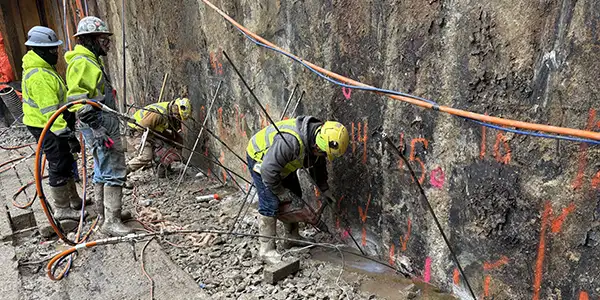
Prevent ground loss and water intrusion through Support of Excavation (SOE) gaps with permeation grouting. This process injects low-viscosity chemical grouts into areas where SOE cannot be installed, binding loose soil into a solid, watertight barrier.
Seepage Control
Stop slow weeping and widespread moisture intrusion without costly excavation. Permeation grouting uses low-viscosity resins that chase water deep into the soil matrix. This creates an impermeable barrier, eliminating dampness and groundwater.
Been There. Grouted That.
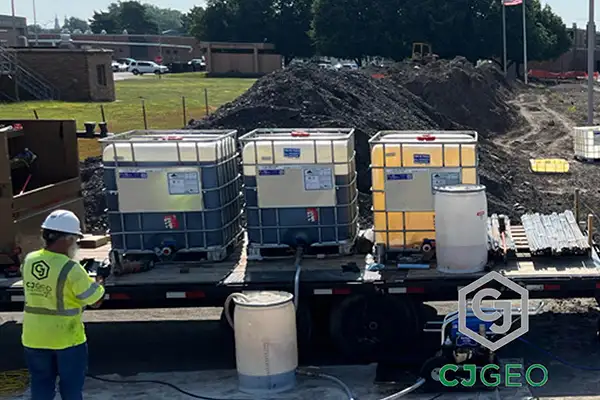
Pump Station SOE Grouting
To prevent groundwater infiltration during a pump station expansion, CJGeo performed SOE closure grouting beneath an adjacent structure. Crews sonic-drilled and installed Manchette tubes, injecting acrylic grout to permeate a water-bearing stone layer and ensure a safe, dry excavation. Read More
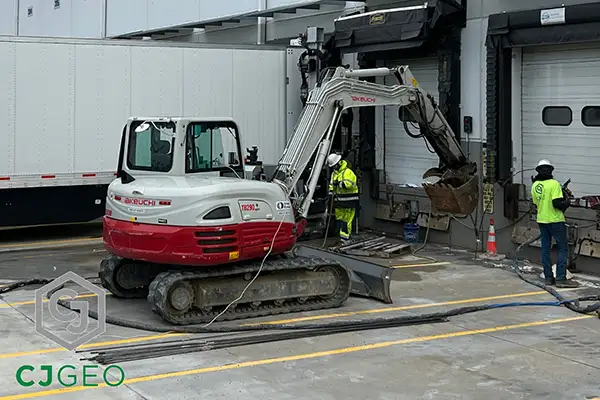
Pennsylvania Permeation Grouting
To fix a heaving distribution center floor caused by expansive shale, CJGeo performed permeation grouting to form a 700-foot waterproof curtain. Using sonic drilling, crews injected highly mobile CJGrout 20SDB polyurethane to permeate the stone, blocking moisture without disrupting operations. Read More
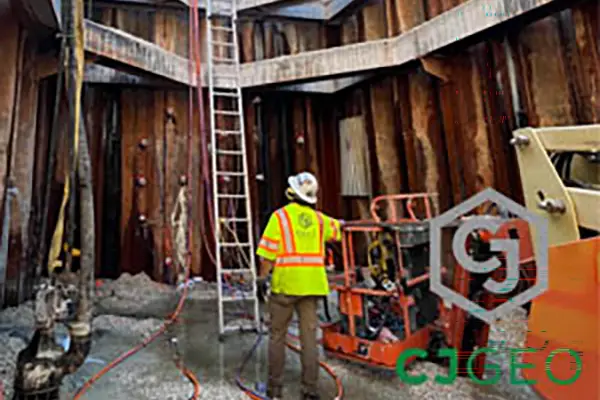
Fort Lauderdale Permeation Grouting
To prevent soil and water inflow during a deep microtunneling project near Port Everglades, CJGeo performed permeation grouting. Crews injected acrylic grout at the launch and retrieval shafts, stabilizing the water-bearing limestone to ensure a safe, dry break-in. Read More
Advantages of Permeation vs Cementitious Grouting
Cleaner
Permeation grouting using acrylic and colloidal silica grouts is significantly cleaner than soil mixing or jet grouting. However, soils treated with permeation grouting generally achieve lower compressive strengths than those treated with cement-based methods.
Smaller Footprint
The equipment used for permeation grouting is generally well-suited for tight laydown conditions. CJGeo's sonic drill is small enough to be craned into tunnel shafts or driven into buildings. Grouting through TAM
Faster
Because the equipment is compact and the process is clean, permeation grouting in tight sites tends to be very efficient, though placement speeds are typically limited by the ability of the soil to take grout (coarser soils take grout faster).
Related Materials
Acrylic Grouts
Engineered with water-like viscosity, non-expansive acrylic grouts uniformly permeate soils without fracturing the subgrade. These formulations are often specified to halt groundwater intrusion and glue soils together. Acrylics excel when access is critical, yielding an impermeable yet hand-excavatable soil mass.
Mineral Grouts
Mineral grouts, such as colloidal silica, feature exceptionally low viscosity and highly controllable reaction profiles. These formulations are completely non-expanding and non-exothermic. Mineral grouts are well suited for permeation grouting through TAM tubing and water cutoff applications.
Plural Component Polyurethanes
Plural component geotechnical polyurethanes are considered a type of chemical grout. However, plural component polyurethanes have significantly different physical properties. Geotechnical and structural polyurethane grouts are highly expansive, rigid formulations that rely entirely on a two-component reaction occurring without moisture.
Prepolymer Chemical Grouts
Prepolymer chemical grouts react with moisture to expand up to 30 times their original volume. Geotechnical site conditions dictate the selection of grouts, while in the field, precise catalysts control the reaction profile. Set times are engineered to match soil characteristics, ambient temperatures, leak volumes, and flow velocity.
Installation Methods
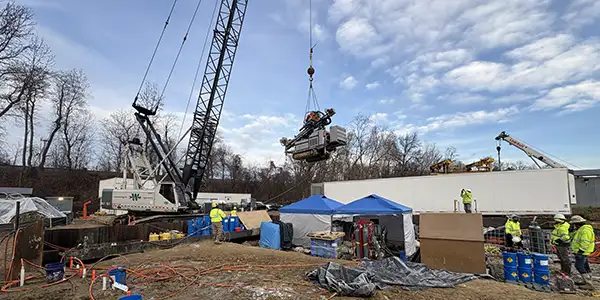
Tube-a-Manchette
TAM (Tube a Manchette) grouting utilizes PVC pipes with cross-drilled holes to isolate injections at precise depths. Due to its small internal ports, this method is strictly used to deliver low-viscosity permeation grouts.
After installation, the down-drill casing is removed, and a cement-bentonite grout is placed around the tubes. Straddle packers capable of isolating individual sets of tubes are then sent down each Manchette pipe to grout specific zones.
CJGeo utilizes a computerized manifold system capable of placing through up to 10 individual placement locations at once
Sacrificial Tubing
Instead of Manchette tubing, driven or washed small-diameter tubing can be used to install permeation grouts. The tubing is typically 0.5-inch steel tubing, which is driven to a particular depth for injection.
After injection at an individual stage, the tubing is either pulled up for the next stage or abandoned in place.
Driven tubing is generally less expensive per linear foot than TAM tubing. However, it does not allow for multiple passes and is less precise.
Frequently Asked Questions
Speak With An Expert
Facing a challenge?
