The Job
This stormwater outfall repair project is located at Hunter Army Airfield. The base is located near Savannah, Georgia. Routine inspection uncovered extensive joint defects on 1,046 linear feet of 84" reinforced concrete pipe. The pipe passes under plane stands, taxiways, and multiple critical utilities.
The original design for rehabilitation called for CIPP lining of the entire length.
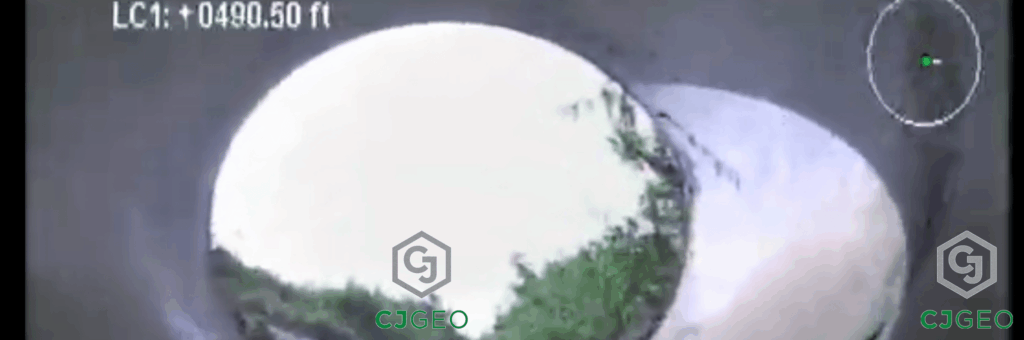
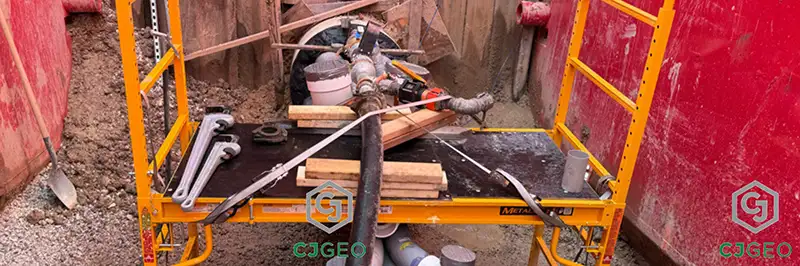
Looking upstream prior to slip lining & grouting.
The Challenge
The pipe rehabilitation contractor determined that performing CIPP would be very difficult. This was primarily due to the length and diameter, complicated by working on an active airfield. The rehab contractor proposed performing slip lining of the pipe using fiberglass pipe as an alternative.
While they no longer had to wet out the liner on an active airfield, they had to place nearly 300 cubic yards of annular space grout at pumping distances up to 600 linear feet.
The Solution
CJGeo implemented a cellular grouting solution using CJ-Fill Standard (ST) at a density of 45 PCF. To address the infiltration, CJGeo worked with the prime contractor to seal the pipe joints using an expansive fiberglass joint sealer. This preparation allowed for a grout density that met the 300 psi compressive strength requirement while remaining light enough for a single pour. The carrier pipe buoyancy was managed entirely through internal water ballasting. This strategy eliminated the need for multiple lifts or complex sacrificial piping. Crews placed 278 cubic yards of cellular grout across two shifts. The process successfully filled the annulus of both pipe runs without shifting the carrier pipes or disrupting airfield operations.
Speak With An Expert
Need help on a project similar to this stormwater outfall repair grouting? Give us a shout.